 #lifeoddsDecision MakingRisk
When You Can't Afford to Lose, Stop Maximizing Expected Value
18 July 2026Here’s a bet: 90% chance you double your money, 10% chance you lose everything. Expected value says take it — it’s massively positive.
Now play it ten times in a row.
Your odds of surviving all ten rounds are about 35%. Two out of three players end up at zero, and zero is not a number like other numbers. You can’t bet your way back from it. The game is over, and the “long-run average” you were promised belongs to somebody else now.
This is the single most important idea in risk that almost nobody applies to their own life: expected value is the wrong thing to maximize when one of the outcomes removes you from the game.
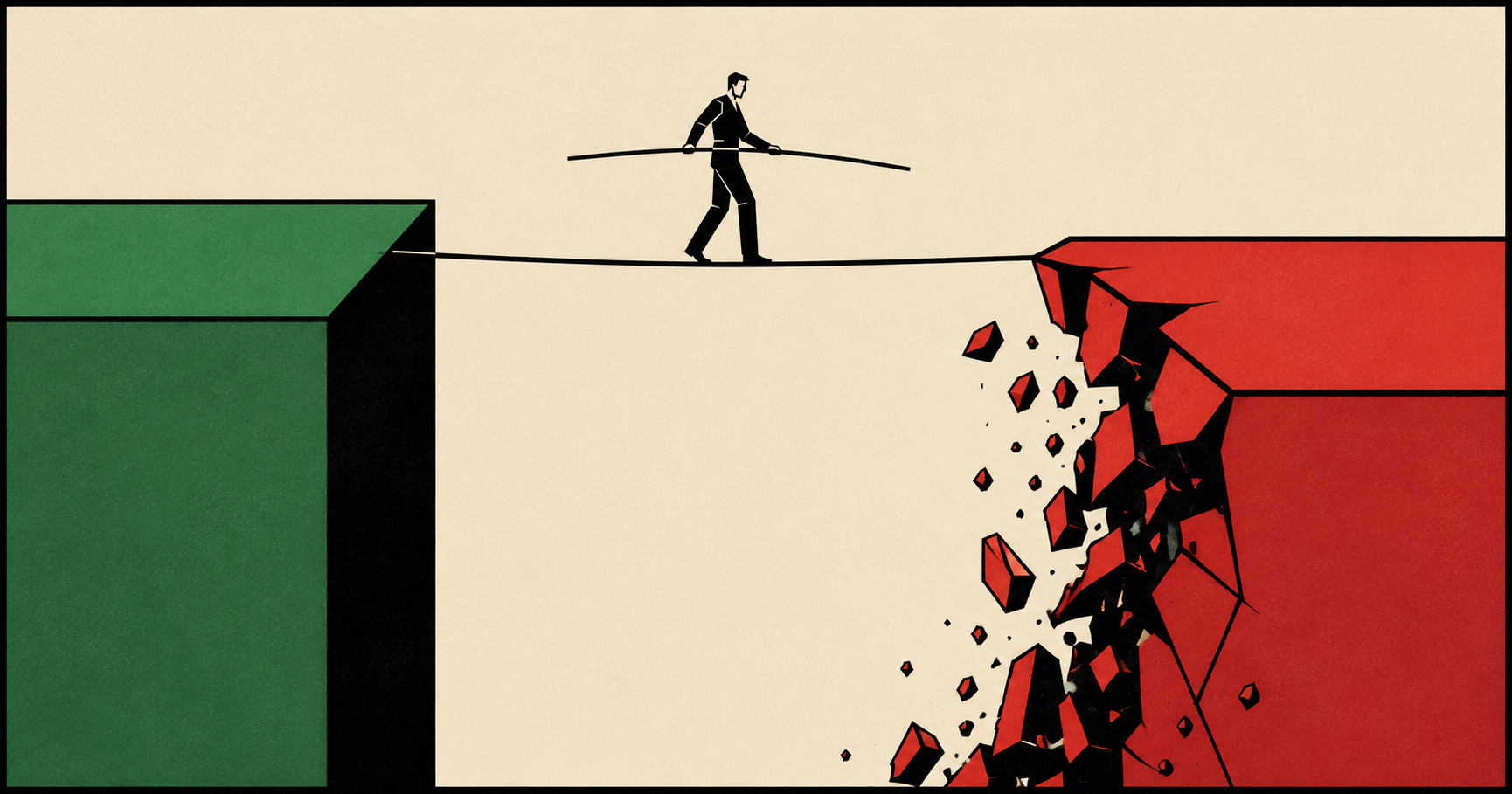
Ruin is not a bad outcome. It’s the end of outcomes.
Decision theory has a name for states you can’t come back from: absorbing barriers. Bankruptcy. A blown professional reputation. Health damage. Burning your savings to zero with dependents at home. What makes these different from ordinary bad outcomes isn’t their size — it’s their irreversibility. A normal loss is a setback inside the game. Ruin ends the game.
This is why “it has positive expected value” is an incomplete argument, and why the standard risk conversation — are you risk-averse or risk-tolerant? — misses the point. Those questions treat risk as one dial. It’s two:
- Variance-aversion is disliking the ride: the swings, the drawdowns, the uncertainty. This is a preference. Reasonable people differ.
- Ruin-aversion is refusing outcomes you cannot recover from. This is not a preference. It’s a constraint — and constraints don’t trade off against upside.
You can tolerate enormous variance while having zero tolerance for ruin. That combination, in fact, describes most successful risk-takers: wild swings, hard floor.
The Kelly trap
Gamblers with a genuine edge have a formula for how much to bet: the Kelly criterion, which maximizes long-run growth. It’s elegant, it’s optimal — and used at full strength, it’s still too aggressive for real life.
The problem is that Kelly assumes you know your true odds. Overestimate your edge — which humans reliably do — and you’re systematically over-betting, and over-betting with a positive edge still ruins you. In the standard setups, betting full Kelly carries roughly a 13% chance of eventual ruin. Half Kelly cuts that to under 2%. Quarter Kelly, to essentially nothing — while giving up surprisingly little growth.
The lesson generalizes far beyond gambling: when your estimates are uncertain, size your bets at a fraction of what looks optimal. The cost of betting too small is a slower climb. The cost of betting too big is that there’s no more climbing.
Floors first, upside second
In the 1950s, the economist A.D. Roy proposed a decision rule that never became as famous as it deserved: instead of maximizing return, first minimize the probability of falling below your disaster threshold. Pick your floor, then choose the strategy least likely to breach it. Safety first — literally.
The practical version for life decisions:
- Name your ruin states, in numbers. “Less than three months of runway.” “Debt I can’t service if I lose my job.” “A reputation hit that closes my industry to me.” Vague dread is useless; explicit floors are checkable.
- Model outcomes as distributions, not predictions. A single expected outcome hides the tail. What you need to know is how much probability mass sits below your floor.
- Reject any strategy with meaningful mass below the floor — regardless of how good its average is. Then, and only then, pick the highest-upside option among the survivors.
Notice the order. You don’t weigh ruin against upside. You filter for survival first, optimize second.
The barbell: safe plus crazy, never medium
Nassim Taleb’s barbell strategy takes this logic to its structural conclusion. Put most of your resources — say 85–90% — in things that are boringly, almost insultingly safe. Put the small remainder into bets with limited downside and unlimited upside. And avoid the middle: the “moderate risk, moderate reward” zone that feels prudent but quietly carries enough tail exposure to hurt you without enough upside to justify it.
The barbell works because it separates money that must survive from money that’s allowed to die. Your safe core makes ruin structurally impossible. Your speculative sliver buys you lottery tickets on the upside — and if every one of them goes to zero, nothing important happens.
The same shape works for a career: a stable income base that covers your floor, plus deliberate, capped-downside experiments on the side — the project, the certification, the tiny startup. Not one big medium-risk swing that could take the whole structure down.
What this means for your next big decision
When you model a decision — take the job, start the company, buy the flat — the question that matters most is not “which option has the better expected outcome?” It’s three questions, in order:
- What does ruin look like here, specifically?
- What’s the probability each option puts me there?
- Among the options that keep that probability near zero, which has the most upside?
This is exactly why LifeOdds simulations report more than a winner. Every run of 1,000 futures shows you the probability of loss for each option — how many of those futures end below where you started — alongside the expected outcome. Two options with similar averages routinely hide wildly different left tails. One of them can survive being wrong. The other can’t.
The people who look fearless from the outside — the ones taking bet after bet, decade after decade — are rarely maximizing expected value. They’re maximizing survival first, and letting the upside compound on top. You can’t win the game you’re no longer in.